
The last thing I typed before going to sleep was an instruction. The first thing I checked after waking up was a production website. Nothing about that sentence would have been possible a year ago.
I have written before about using Claude to design websites and about what Claude Code can do with a single well-structured prompt. Those posts were about design. A beautiful page, an afternoon of work, a wow moment.
This post is about something different. This is about Claude Fable 5 running an entire production migration end to end, overnight, with no human in the loop. Not a landing page demo. A real site, on a real domain, with real traffic, moving off a paid platform onto new infrastructure, with all the invisible plumbing that makes a website findable: SEO, GEO, and AEO included.
Here is exactly what I asked for, what I woke up to, and why the boring parts of what it did matter more than the pretty parts.
The Instruction: "Don't Ask for Any Approvals"
My personal brand site, thepmfguy.com, was running on Framer. Framer is a genuinely good product. But I was paying a subscription for what is, at the end of the day, a static marketing site. And every change meant opening a visual editor and fiddling with it myself.
I had already given Claude all the context it needed over previous sessions: my positioning, my numbers, my services, my brand voice, the pages I wanted, the platforms I am on, who my audience is. So before going to bed, I gave Claude Fable 5 one instruction. Paraphrasing only slightly:
"Don't ask for any approvals from me. By the morning, when I'm up, make sure everything is done and dusted."
That is the whole brief. No wireframes. No task list. No checkpoints. The two things that made this possible: the model was capable enough to be trusted with production access, and I had already front-loaded the context so it never had to guess what I wanted.
What I Woke Up To
thepmfguy.com, live, fast, and completely rebuilt. Nine pages: a homepage, a media kit, a collaboration page, and six work showcases covering AI product ads, SaaS ads, an AI micro-drama series, launch videos, agentic content automation, and real estate AI videos. All of it serving from Cloudflare's global edge network on the free tier.
These are screenshots of the live production site. Click through the tabs:
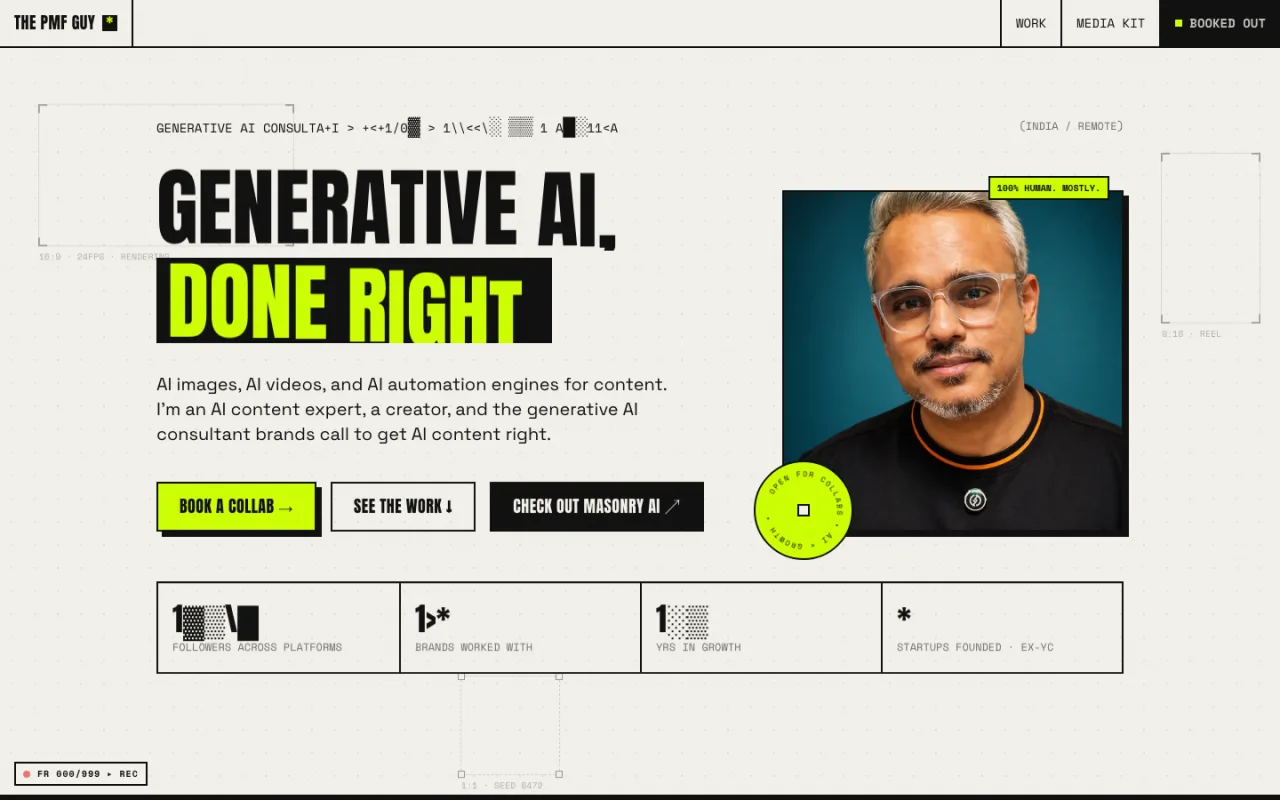
The homepage. A bold, brutalist direction with neon accents. Nothing like my old Framer template, and that was the point.
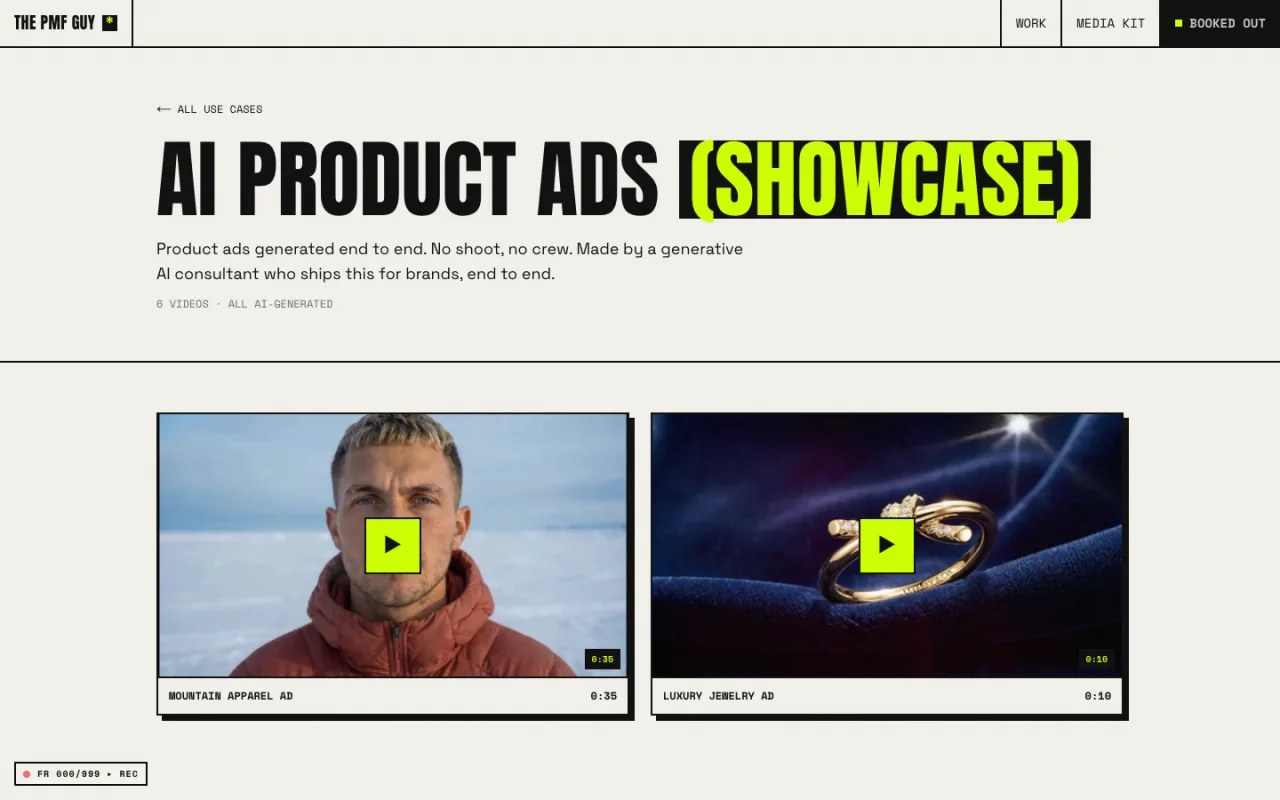
One of six work showcase pages, each with embedded video work and its own meta and schema setup.
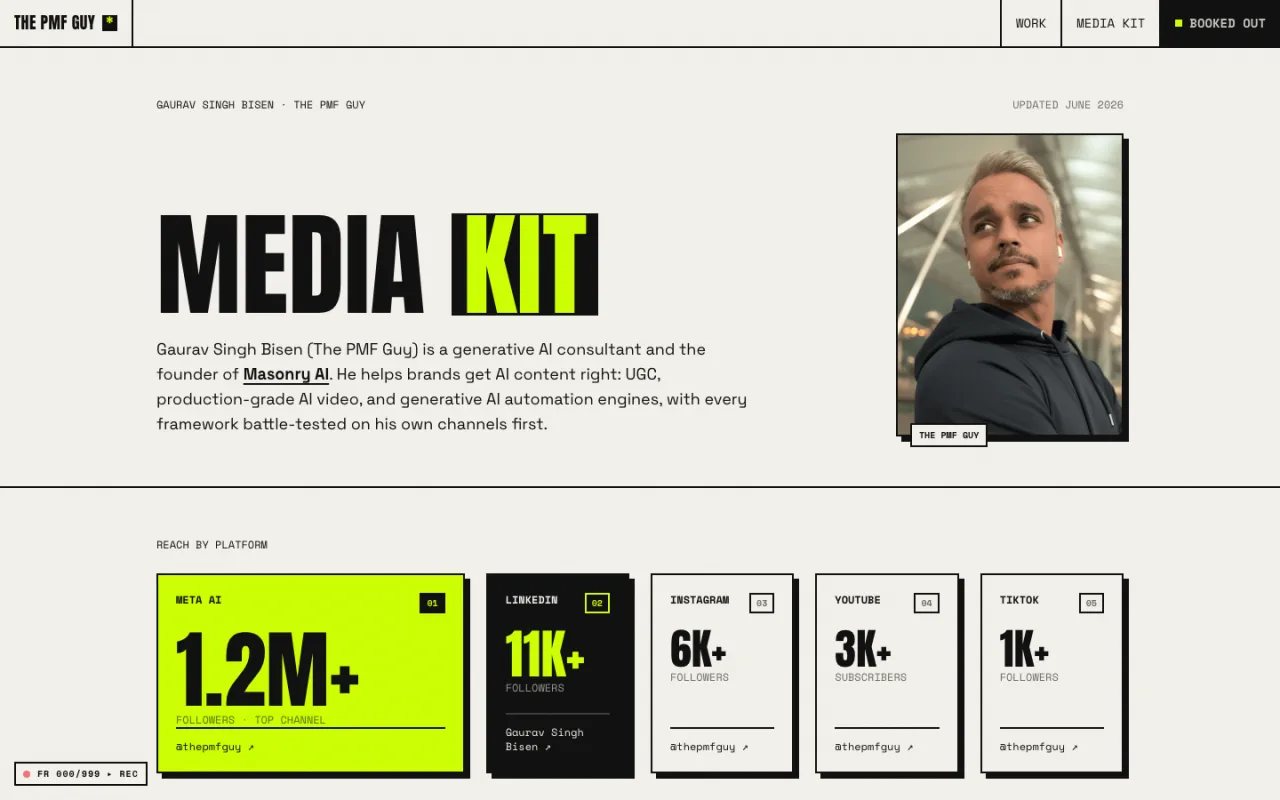
The media kit, with live platform numbers: 1.2M+ on Meta AI, 11K+ on LinkedIn, plus YouTube, Instagram, and TikTok.
The Migration: Goodbye Framer Subscription, Hello Free Tier
The headline financial outcome is simple. I was paying Framer every month to host a static site. I now pay nothing. Claude rebuilt the site as a modern web app, deployed it to Cloudflare, moved the domain over, and the subscription got cancelled.
Paid subscription, visual editor
A recurring monthly bill for hosting and a site I could only change by opening an editor and dragging things around myself. Every edit was my time.
$0/month, edge-served, agent-editable
A codebase Claude can edit directly. Deployed on Cloudflare's free tier, cached at the edge worldwide. Every future change is one instruction away.
The money matters less than what the money represents. The subscription was not really paying for hosting. Static hosting has been effectively free for years. It was paying for the interface between me and my website. The visual editor, the publish button, the abstraction that made web publishing accessible to a non-developer.
An AI agent that writes and ships production code makes that entire layer optional. I do not need an interface I can operate. I need an agent that can operate the real thing. The site is now plain code in a repository, which is the most agent-friendly format a website can possibly be in. Claude reads it, edits it, deploys it, verifies it. The visual editor was a workaround for people who cannot write code. I have something better than the workaround now.
Website builders sold us an interface to avoid code. AI agents made code the easier interface.
SEO, GEO, AEO: The Unsexy Part It Did Not Skip
Anyone can get a model to generate a pretty homepage. The real test of "production-ready" is the invisible layer. The stuff nobody screenshots for X. This is where most AI-built sites quietly fail, and it is the part I was most skeptical about when I woke up.
Quick definitions, because these three acronyms are converging into the discipline that will define discovery for the next decade:
- ✓SEO (Search Engine Optimization): being findable and rankable by Google and Bing. Titles, descriptions, canonicals, sitemaps, structured data.
- ✓GEO (Generative Engine Optimization): being readable and citable by AI models. Letting AI crawlers in, publishing llms.txt, writing content machines can lift accurate answers from.
- ✓AEO (Answer Engine Optimization): being the answer, not just a result. FAQ schema, speakable content, entity-rich pages that ChatGPT, Perplexity, and Google AI Overviews can quote directly.
Here is what is actually live on thepmfguy.com right now. Not what Claude claimed it did. What I verified in production the next day.
The robots.txt welcomes the machines
Most sites either block AI crawlers out of fear or never think about them at all. For a personal brand whose entire business is being known for generative AI, being visible inside AI tools is distribution. Claude wrote a robots.txt that explicitly allows fifteen AI crawlers by name:
User-Agent: GPTBot
Allow: /

User-Agent: ClaudeBot
Allow: /

User-Agent: PerplexityBot
Allow: /

User-Agent: Google-Extended
Allow: /

# ... plus OAI-SearchBot, ChatGPT-User, Claude-User,
# Claude-SearchBot, anthropic-ai, Perplexity-User,
# Applebot-Extended, meta-externalagent, CCBot,
# Bytespider, cohere-ai

Sitemap: https://thepmfguy.com/sitemap.xml
An llms.txt that introduces me to every AI model
llms.txt is the emerging standard for telling language models what a site is about in a format they can parse cleanly. Claude wrote one that reads like a press kit for machines, plus a longer llms-full.txt companion with the extended version:
# The PMF Guy / Gaurav Singh Bisen

> Gaurav Singh Bisen (The PMF Guy) is a generative AI
> consultant, AI content expert, and creator. He helps
> brands get AI content right: AI UGC, production-grade
> AI videos, AI images, and generative AI automation
> engines built on Claude Code and CLI workflows.

Key facts:
- Reach: 1.2M+ followers on Meta AI, 11K+ on LinkedIn
- Services: generative AI consulting, AI video production,
  agentic content automation, AI content strategy
- Contact: thepmfguy@gmail.com
And the full checklist underneath
- ✓XML sitemap with all nine pages, lastmod timestamps, and priorities, referenced from robots.txt.
- ✓Four JSON-LD schema blocks on the homepage: Person (with sameAs links to every social profile), WebSite, Service, and FAQPage.
- ✓Canonical URLs, Open Graph, and Twitter Card tags on every page, with a dynamically generated 1200x630 OG image.
- ✓llms.txt and llms-full.txt served at the root, structured for machine consumption.
- ✓Preloaded self-hosted fonts and edge caching. The site comes back with a Cloudflare cache HIT and loads instantly.
The part that gets me: I never listed any of this in the instruction. "Make sure SEO, GEO, and AEO are handled" was the level of detail it got. The fifteen named crawlers, the FAQPage schema, the llms-full.txt companion file, the sitemap priorities. All of that is Claude Fable 5 knowing what "handled" means at a production standard and just doing it.
Why This Worked: Context Beats Prompts
I want to be precise about the lesson here, because "I slept and AI did everything" is the kind of line that gets dismissed as hype. I have written a whole essay about AI promises versus reality, so I hold myself to the same standard.
This did not work because of one magic prompt. It worked because of three things stacked together:
- 01 Front-loaded context. Over previous sessions, Claude already knew my positioning, my numbers, my services, my clients, my voice, and my goals. The overnight instruction was the trigger, not the brief. If you give an agent thin context, you get a generic site at 7 a.m. instead of your site.
- 02 Real autonomy, explicitly granted. "Don't ask for any approvals" is doing enormous work in that instruction. Agents default to checking in, and every check-in at 3 a.m. is a dead workflow. The capability to run unsupervised already exists. Most people have just never granted it.
- 03 A verifiable definition of done. "Live on the domain, old subscription gone, SEO/GEO/AEO handled" is checkable. The agent can curl the production URL, inspect its own robots.txt, validate its own schema, and keep iterating until reality matches the goal. Vague goals stall autonomous agents. Verifiable ones let them loop.
This is the same pattern I tell every founder I work with: the quality of agent output is a direct function of the quality of context you maintain, not the cleverness of the prompt you type. Claude Fable 5 raised the ceiling on what the agent can execute. The floor is still set by what you feed it.
What This Means If You Are Paying for a Website Builder
I am not telling you Framer is bad. It is excellent at what it was built for. I am telling you the category it sits in just got repriced.
The website builder market built its margins on a simple premise: code is hard, so pay us monthly for an interface that avoids it. That premise is now false for anyone willing to work with an AI agent. The agent writes the code, ships the code, and maintains the code, and the hosting underneath has been commoditized to zero by platforms like Cloudflare.
The practical takeaway is not "cancel everything tomorrow." It is this: the next time a subscription renewal hits your inbox, ask whether you are paying for capability or for an interface. Capability is worth paying for. Interfaces to capabilities that agents now handle are the first line item to die in every budget I have seen this year.
My website used to be a monthly bill and a chore. It is now a codebase that improves while I sleep. That trade is available to anyone, today, and it costs less than what you are currently paying.
Want this kind of agentic setup for your own brand or product?
I help founders and brands build generative AI systems that actually ship: content engines, agentic workflows, and AI-built sites that are production-grade down to the schema layer. If you want a second pair of eyes on your setup, book a session.
Book a Growth Chat
Everything described in this post was verified against the live production site at thepmfguy.com on June 12, 2026: response headers confirming Cloudflare edge serving, the public robots.txt and llms.txt files, the XML sitemap, and the JSON-LD structured data embedded in the homepage. The screenshots are unedited captures of the live site.