
Every tool, every product launch, every model drop. They are all selling the same thing. And once you see it, you cannot unsee it.
Ever since OpenAI released the first version of the ChatGPT app and opened up their API to the public, I have been in this space. Not as an observer. As someone who has used, tried, tested, broken, loved, and moved on from more AI tools than I can count.
I am a marketer. A growth and GTM person. Not a developer. And yet I found myself using Cursor, a coding tool, because what it was promising was too hard to ignore. Then I moved from Cursor to Claude Code. I have been in the image and video AI world since the days of Stable Diffusion, Civit AI, and training models on LoRA. I was on Midjourney when it was still running on Discord. I have tried every image model, every video model, every writing tool, every agent framework that has come out in the last three to four years.
I have lived this from both sides. As a consumer trying everything, and now as a founder building something. Which means I am also doing the exact same thing I am about to describe.
Here is the thing nobody is saying out loud: every single AI product being built and launched right now is selling you a promise. Not a product. A promise. And I am one of them too.
By the time you finish reading this, you will understand why that is not a bad thing. And why it might be the most important thing happening in the world right now.
Open the App Store. Watch Any Launch Video. It Is All the Same.
Every day there is a new launch video on X or LinkedIn. A new demo. A new funding announcement post. A new "we just shipped" tweet from a founder who looks like they have not slept in three days.
And if you watch enough of them (which I have), you start to notice something. They are all trying to sell the same thing. A promise.
Not the same product. Not the same category. Not even the same problem. But the same core message underneath all of it: your future will be different from your present. You will automate the thing that drains you. You will do in minutes what used to take hours. You will be able to do more with less, move faster with fewer people, and finally get to the work that actually matters.
That is a promise. And right now, the entire AI industry runs on it.
This is not a bad thing. When I say promise, I do not mean deception. I do not mean fraud. There is a real difference. Deception is selling something you know will not work. A promise is selling something you believe will work but cannot fully prove yet. Almost every AI product being built right now sits in that second category.
The founder believes it. The VC believes it. The early adopter believes it. But the data behind most of it is thin. The products being built today are solving problems people assume exist, for users they have not fully talked to, in a category that shifts every three months as new model capabilities drop.
That is the reality. And here is the thing. That is fine. Because this is not a market yet. This is a construction site.
Before the Promise Can Be Delivered, the Foundation Has to Be Built
Here is the part most people miss. The reason the promise has not been fully delivered yet is not because AI does not work. It is because the infrastructure needed to deliver it is still being assembled.
Think about it as a stack. Each layer depends on the one below it. And right now, the world is building all of them at the same time.
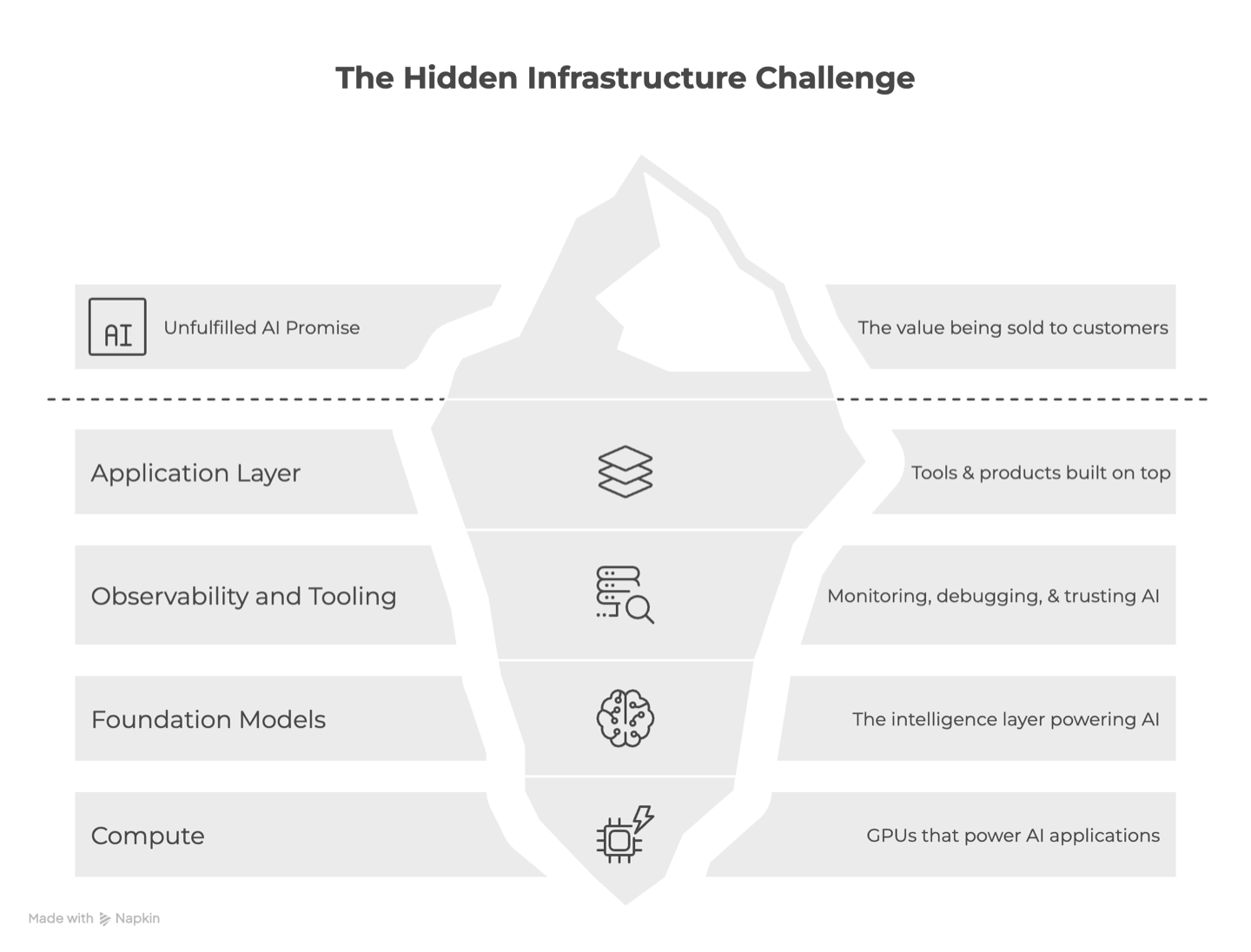
Here is the key point: for the promise to be fulfilled, all of these layers have to come together. Not one of them. All of them.
You cannot have a great AI application without reliable models. You cannot trust the models without observability. You cannot scale any of it without the compute. Every single launch happening today is a bet on a future where all these layers are mature, stable, and working together seamlessly.
That future is being built. But it is not here yet. Which is exactly why everything still feels like a promise.
The Closest Parallel Is Not What You Think
Compare this to the dot-com boom. Yes, the investment is similar. The biggest tech companies in the world pledged over $320 billion in AI infrastructure in 2025 alone. The Stargate Project is planning a $500 billion AI data center network. Microsoft, Meta, Amazon, Google, and Tesla have collectively spent around $560 billion on AI infrastructure over the last two years. Their combined AI-related revenue so far? About $35 billion.
That gap looks scary if you think of it like a bubble. But it looks completely rational if you think of it like laying cable.
In the 1990s, telecom companies laid over 80 million miles of fiber optic cable across the US. Most of them went bankrupt. But the cables stayed in the ground. And everything we use today (streaming, cloud storage, video calls, remote work) runs on that exact foundation.
That is what is happening now. The infrastructure is being laid before the applications exist. The cables are going in the ground. And the applications that run on top of them, the ones that make this all feel obvious in hindsight, are still being figured out.
But here is what makes this moment genuinely different from the dot-com era. The speed.
SpaceX Took Years to Ship a Rocket. Anthropic Compresses a Decade Into a Quarter.
Think about SpaceX for a second. Elon Musk started it in 2002. The first successful orbital launch was in 2008. Six years later. Building physical rockets that work requires years of iteration, hardware manufacturing, regulatory approvals, and tests where things literally blow up.
Anthropic was founded in 2021. By 2025, it was generating more revenue in a single month than SpaceX generates in an entire year.
2002 to 2008
Six years from founding to first successful orbital launch. Hardware iteration, regulatory cycles, physical testing.
2021 to 2025
Four years to a revenue run-rate higher per month than SpaceX makes per year. Pure software compounding on better models.
That is not just a funding story. That is a compression story. The AI era is moving at a speed that has no real precedent. Not even the internet era. Every six months, the foundation models get meaningfully better. Every year, the cost of compute drops. Every quarter, new capabilities unlock that were not possible before.
This changes the math on the promise entirely. In the internet era, you had to wait a decade or more for the foundation to be ready. In the AI era, the foundation is being built and improved in near real time. The gap between the promise being made today and the promise being delivered is shrinking faster than anyone expected.
The infrastructure is not just being laid. It is being laid fast.
Every Launch Is a Guess. But It Is an Increasingly Informed One.
Here is the honest thing nobody says out loud at a product launch or pitch meeting: most AI products being built today do not have enough data to know if they will work.
The founder had a problem, usually their own, and thought: AI could probably solve this. So they built it. That is not a process grounded in deep research or validated demand. It is an educated guess dressed up in a product brief.
And yet the launches keep coming. Because the cost of being wrong has dropped and the cost of not trying has gone up.
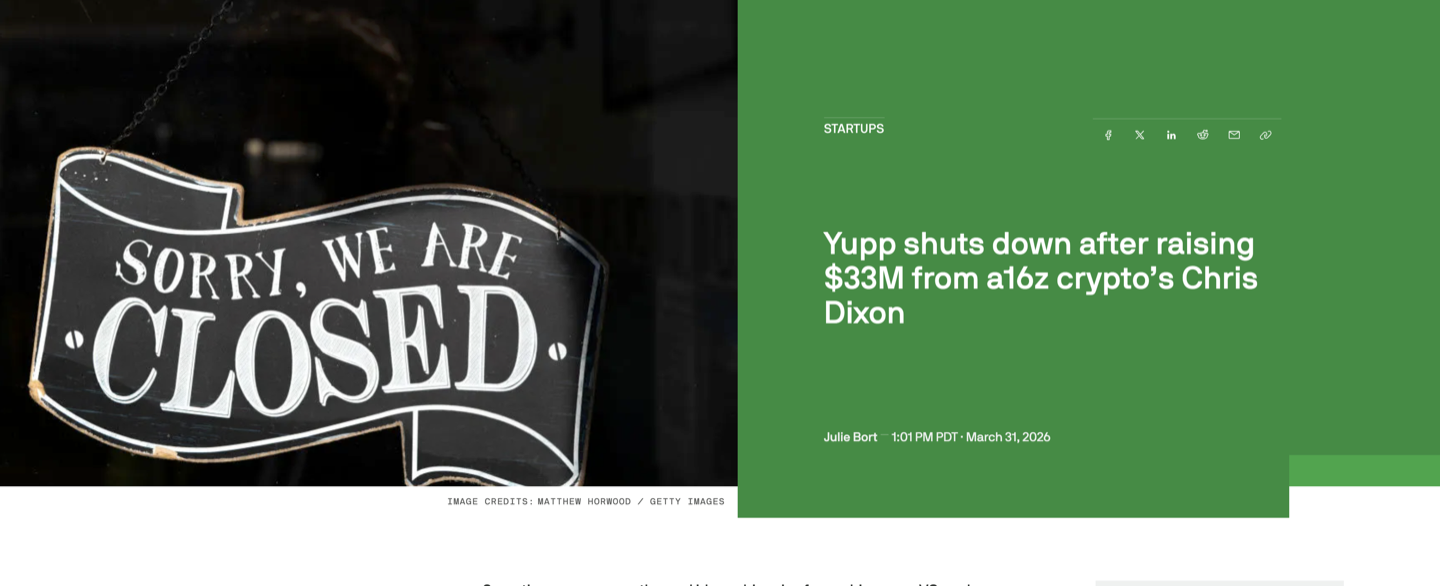
The receipts on guessing wrong. Yupp.ai raised $33 million from Andreessen Horowitz and some of the biggest names in Silicon Valley. It shut down less than a year later, unable to find product-market fit before the AI landscape under it completely changed. OpenAI launched Sora as a standalone app. It got 12 million downloads. But its 30-day retention was under 8%. Even the best-funded, best-resourced products in the world are figuring this out as they go.
In 2025, more AI startups at the Series A stage failed than in any prior year. The market is not forgiving people who guess wrong. But it cannot stop people from guessing, because the potential upside is too large, and because each failed guess teaches the market something the next guess benefits from.
Fewer Employees. More Founders. And It Makes Perfect Sense.
One of the clearest signs that we are in a promise-driven era is what is happening to the structure of the market. There are more founders now and fewer employees. Not because employment disappeared, but because the calculation has shifted.
Maor Shlomo built an AI startup called Base44 entirely by himself. Six months. 300,000 users. $3.5 million in ARR. He sold it to Wix for $80 million in cash.
That story spreads because it makes the promise feel real. And when a promise has a real example attached to it, more people try.
The Selfish Truth Nobody Wants to Say Out Loud
I have met a lot of founders in the last few years. In person, over calls, over DMs. And every single one of them, no matter what they say about changing the world or solving a real problem, has the same thing running underneath it.
They do not want to miss this. And I say that because it is true for me too.
We know from history that every major technology wave had a window. The internet era had its window. Roughly 1993 to 1999. The people who built during that window (Amazon, Google, Salesforce, Cisco) defined a generation. The people who tried to build the same kinds of companies in 2004 found the ground had already been staked.
The SaaS era had its window. The consumer app era had its window. Hundreds of thousands of people must have seen those moments and either acted too late, or did not act at all, and spent the rest of the decade watching someone else build what they had imagined.
The AI window is open right now. Everyone can feel it, even if they cannot articulate it. And that feeling, the rational, historically accurate sense that missing this moment is something you cannot undo, is what is driving everything. More people building, less time thinking. More launches, fewer validated ideas. More capital flowing in, less patience for slow results.
It is selfish. It is completely understandable. And it would actually be strange if people were not acting this way.
The Part I Have to Be Honest About
I said at the start that I am also selling a promise. Let me be more specific about that.
Every person building in this space right now is betting on a direction, not a certainty. You cannot run a study to prove where the world is going in three years. You can reason about it, use your experience to make a more informed call than most. But at the end of the day, it is still a bet.
What separates an informed bet from a blind one is the depth of the journey behind it. Four years of using almost everything, knowing what good looks like and what it does not, knowing where AI genuinely solves a problem versus where it is just rewrapping something that already existed. That does not remove the promise. But it makes it more grounded. And that is the most anyone can honestly claim right now.
What We Do Not Know Yet
I want to be fair about what nobody has figured out yet.
We do not know which AI categories will actually survive as foundation models get better and cheaper. A lot of products making money today are built on capabilities that may become free features inside tools people already use. The writing assistant that charged $30 a month in 2023 may be a free button in Google Docs by 2026.
We do not know if the productivity gains showing up for individual users will ever show up in company results. 78% of enterprises have adopted AI tools. Only 23% can actually measure the return on what they spent. A 2025 MIT study found that 95% of organizations are getting zero measurable return on their generative AI investments.
And we do not know if the investment level is sustainable. Big Tech has spent $560 billion on AI infrastructure. Combined AI revenue so far is $35 billion. That math either resolves through explosive growth, or it does not. History gives both possibilities.
What This Means If You Are Reading This
- 01 If you are a founder building in AI right now, you are not just building a product. You are placing a bet on a foundation being laid under your feet in real time, and trying to build on top of it before the ground stops moving.
- 02 If you are a user trying to figure out which AI tools are actually worth your time: ask whether this changes how you work in a way that holds up after the first week. Most tools will excite you on day one. Very few will still be part of your workflow on day 90.
- 03 If you are stepping back and trying to understand what this moment actually is: we are not in a product market. We are in a foundation era. The things being built right now are not the final products. They are the experiments that teach us what the final products need to be.
For the full promise to be delivered (the one where work actually looks different, where the productivity gains show up in real numbers, where the foundation stack is complete and humming), all the layers have to come together. Compute. Models. Observability. Applications. Every layer dependent on the one beneath it.
That is still being built. All of it. At the same time. At a speed that has no historical comparison.
By 2030, and definitely by 2040, the world will look fundamentally different across every vertical and category. Not because of any single product being built today. But because of the cumulative weight of thousands of experiments, hundreds of failures, dozens of breakthroughs, and an enormous amount of infrastructure being assembled right now.
The people who will be remembered as having shaped that world are working on it today. Most of them do not know yet whether their specific bet will pay off. But they know they are in the right era to make it.
Building in AI and trying to figure out the promise vs the product?
I work with early-stage AI founders on positioning, GTM, and the messy middle between an exciting demo and a workflow people will actually pay for on day 90. If you want a second pair of eyes on what you are building, book a session.
Book a Growth Chat
Data in this piece is drawn from Crunchbase's 2025 venture funding reports, KPMG Venture Pulse, MIT research on enterprise AI ROI, Carta's Solo Founders Report 2025, a16z State of Consumer AI 2025, and multiple analyses comparing the AI era to the dot-com period.